
Monday, October 20, 2008

Description
Ribosomes are like the construction workers of the cell. They build polypeptide chains one amino acid at a time. In eukayotic cells, they can add 2 amino acids to a protein chain in a second, and in prokayotic cells they can add up to 20 amino acids in a second. They are very small, and can only be seen through an electron microscope. They can be found floating free in the cytoplasm of the cell, or bound to the endoplasmic reticulum. Proteins produced by 'free' ribosomes are used inside the cell, and proteins produced by 'bound' ribosomes are used inside the cell as well as exported out of the cell. The proteins that they make are used as enzymes or as support for other cell functions.
Structure
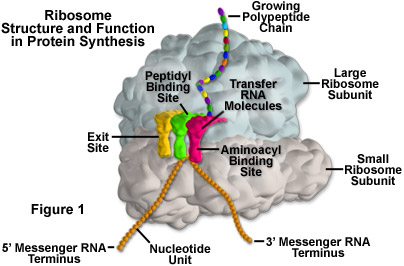
 Ribosomes are composed of two subunits, one large and one small. In eukaryotic cell the large subunit is 60-S and the small is 40-S. In a prokaryotic cell the large unit is 50-S and the small is 30-S. The S stands for Svedberg value. In both the eukaryotic and prokaryotic cell the subunits are made of ribosomal proteins and rRNA strands. These subunits although seperate, combine and work together as one unit when translating mRNA into a
polypeptide chain.
Function
The function of ribosomes is to translate RNA into proteins. The process starts with messenger RNA (mRNA) which is produced in the nucleolus. The mRNA is like a blueprint for the ribosome. It tells the ribosome which amino acid to produce, in which order, and when to end a chain. The genetic information in mRNA is organized into codons, each of which has three nucleotides. The ribosome then pairs the information provided from the mRNA with the correct transfer RNA (tRNA) which provides the amino acids. The amino acids go through the ribosome and produce a polypeptide chain.
Saturday, October 18, 2008
Why Ribosomes ROCK!
 ~ Proteins are essential for all cell
functions.Without ribosomes, the
protein synthesizers, cells would
not be able to make proteins;
meaning no other cell functions
could take place. For instance in
order for lysosomes to function
they use multiple digestive
enzymes, such as Carbohydrases
(digest carbohydrates) which are
made from proteins.
~ The difference in the size of prokaryotic and
eukaryotic subunits may be small but has
enabled scientists to create drugs that have the
ability to kill prokaryotic microorganisms that
may cause disease.
~ The proteins that ribosomes produce are
used in constructing other organelles, along
with the cell membrane. Ribosomes are essential
to the survival of the cell.
LEAST important organelle

Recently it has been discovered that centrioles are no longer required for mitosis. Scientists have removed them with lasers and cells can still undergo the process of mitosis.
Subscribe to:
Posts (Atom)

